3 September 2026
Investing by evidence
By Peter Robbins

Key points
- Successful investing is less about predicting what markets will do next and more about making a series of sensible, evidence-based decisions over time.
- We favour productive assets, broad global diversification and a disciplined long-term investment strategy rather than trying to identify tomorrow’s winning markets or funds.
- Keeping investment costs under control, systematically rebalancing portfolios and avoiding emotional reactions to market movements can all play an important role in long-term outcomes.
- Decades of academic and market research suggest that certain risks, including exposure to smaller and value companies, have historically rewarded patient investors over the long term.
- Good investment outcomes rely not only on choosing the right strategy, but on implementing it consistently using high-quality, diversified investments.
Eight decisions that shape how we invest your money
Every investor would love a crystal ball: which markets will do best next year, which funds will come out on top, when the next downturn will hit. Adverts and headlines often talk as if someone has the answers. In reality, almost nobody does, not reliably and not consistently. Investing is, in the end, about making decisions without certainty.
The good news is that you don’t need certainty to invest well. What you need is a series of sensible decisions that quietly stack the odds in your favour, sometimes only a little at a time.
Figure 1: Start with the evidence

No single decision guarantees success on its own. Put a group of sensible decisions together into one disciplined process, though, and you give yourself a far better chance of a good outcome over the long term.
This article walks through eight of the decisions that shape how we invest, along with some of the evidence behind each one. It only scratches the surface of what we actually draw on, but it should give you a clear sense of the thinking.
- Own real assets, not just cash
Our choice: Own productive assets and participate in the rewards of capitalism
When you invest in shares, you become part-owner of a real business, one that employs people, builds products and, hopefully, turns a profit. Over time, successful businesses create wealth, and some of that flows back to their owners through dividends and rising share prices. It’s why we choose to own productive assets rather than sit in cash.
History backs this up. Shares have delivered substantially higher long-term returns than cash or bonds, even though the ride is bumpier along the way.
The numbers: between 1979 and 2025, global shares grew by around 7.8% a year after inflation, against roughly 2.4% for high-quality bonds1. Compounded over that time, the gap becomes tenfold.
2. Build robust portfolios
Our choice: Accept that markets are difficult to second-guess and build robust portfolios
Financial markets are crowded with millions of people, all trying to work out the same thing at the same time. If there were an easy way to spot tomorrow’s winner, it wouldn’t stay easy for long, someone would already have found it.
So rather than trying to predict what happens next, we build robust portfolios that can keep growing regardless of what the market throws at them. That means putting our energy into the decisions we can actually control, not predictions nobody can reliably make.
The track record here is hard to ignore. Most professional fund managers fail to beat the market over the long run, particularly once fees are taken into account. The mix of investments you hold matters far more to your outcome than trying to pick winners.
The choice and adherence to a long-term asset allocation is the core driver of portfolio risk and return. Active winners and losers largely cancel each other out, leaving exposure to asset classes as the dominant determinant of outcomes2.
3. Diversify or concentrate
Our choice: Diversify widely
Nobody can say with certainty which company, country, sector or investment style will come out on top. Spreading your money widely is the simplest way to protect yourself from getting that guess wrong.
Today’s markets contain tens of thousands of companies across almost every industry and region. Owning a broad slice of all of them means you benefit from the collective ingenuity of the global economy, rather than depending on a handful of individual success stories. Modern investment funds make this easier and cheaper to do than ever.
Here’s what the data shows: since 1926, just 4% of listed companies have generated all of the stock market’s returns put together, and most individual companies actually performed worse than cash3. Owning the whole market is a far more reliable approach than betting on a handful of names.
4. Keep costs low or take on expensive talent
Our choice: Keep costs low, but not at the expense of quality
Costs are one of the few things about investing you can control with certainty.
Every pound spent on fees, trading and tax is a pound no longer working for you. These deductions might look small on paper, but over years and decades they add up to a real difference in your outcome.
Here’s a simple way to think about it: before costs, all investors together earn “the market return.” Once fees come out, the average investor is left with less than that. So the less you pay, the further ahead you start.
Fund costs are one of the most reliable predictors of how well a fund goes on to perform. Lower fees, more often than not, mean better outcomes for you4.
5. Rewarded risks or market portfolio
Our choice: Tilt towards rewarded risks
This is a subtle point, but an important one. A broad spread of investments is a sensible starting point for anyone. But not every company is identical, and decades of research suggest that certain types, smaller companies, and those trading cheaply relative to their underlying worth, have tended to reward investors a little more over long periods.
That doesn’t happen every year, nor should you expect it to. But because these companies generally carry more risk, patient investors have historically been paid for holding them.
Since 1972, smaller and “value” companies have outperformed a broad market portfolio by around 1 to 2%5 a year. Over a lifetime of investing, that’s a meaningful difference.
6. Be patient or react
Our choice: Be patient and take a long-term view
Every generation of investors believes their moment feels uniquely dangerous. Yet market falls, recessions and crises have always been part of investing, from Tulip Mania in 1637 through to the pandemic crash of 2020.
The temptation, when things feel shaky, is to do something. Unfortunately, investors tend to get the timing backwards, growing confident once markets have already risen, fearful once they’ve already fallen. That kind of reactive behaviour erodes long-term returns.
Investors who chase performance or panic-sell typically earn around 1.2% less a year than those who simply hold their nerve6.
7. Rebalance on purpose or let a let it drift
Our choice: Rebalance systematically
When shares rise strongly, they naturally take up a bigger slice of your portfolio than you originally intended, and vice versa when they fall. Left alone, your level of risk can drift a long way from where it started.
Rebalancing means periodically bringing your investments back to their original targets: selling a little of what’s done well, topping up what hasn’t. It can feel counter-intuitive, even uncomfortable, but it keeps your portfolio at the risk level chosen for you in the first place.
Left untouched, a portfolio that started with 60% in shares could have drifted to as much as 80%7 in shares over just ten years (May 2016 to April 2026). That’s a very different, and considerably riskier, portfolio to the one you signed up for.
8. Own the right assets poorly or own them efficiently
Our choice: Use high-quality funds and implementation
Even the best investment thinking can be undermined by poor execution. Once decisions have been made about spreading your money and managing risk, they need to be carried out well.
We look for funds that are highly diversified, run systematically (by research and evidence rather than opinions), and focused on capturing the returns their markets have to offer, rather than chasing the next star manager or last year’s winner. That means searching carefully across hundreds of thousands of possible funds. As an independent firm, we’re free to choose whichever ones genuinely earn their place.
Over a 20-year period, only around 2% of professional fund managers beat a fair benchmark once costs and risk were properly accounted for8. Choosing funds on past performance alone is, more often than not, a losing game.
Figure 2: Stack the odds in your favour
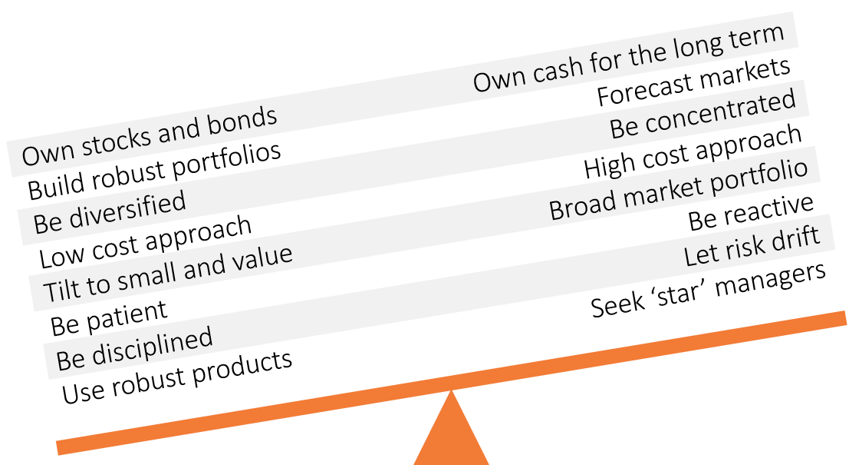
No investor can control what markets do. Every investor can control the decisions they make, and guided by evidence, those decisions are what give you the best chance of a good outcome
Important notes
This is a purely educational article to discuss some general investment-related issues. It does not in any way constitute investment advice or arranging investments. It is for information purposes only; any information contained within it is the opinion of the authors, which can change without notice. Past financial performance is no guarantee of future results.
General Investment Risk Warnings
Please remember the value of your investments and any income from them can go down as well as up and you may get back less than the amount you originally invested. All investments carry an element of risk which may differ significantly.
If you are unsure as to the suitability of any particular investment or product, you should seek professional financial advice. Tax rules may change in the future and taxation will depend on your personal circumstances. Charges may be subject to change in the future.
Products referred to in this document
Where specific products are referred to in this document, it is solely to provide educational insight into the topic being discussed. Any analysis undertaken does not represent due diligence on, or a recommendation of, any product under any circumstances and should not be construed as such.
Sources
- Inflation: UK RPI (to 01/1988), UK CPI thereafter. Bonds: Albion Short Gilt Index (0–5). Equities: Albion World Stock Market Index. Returns in GBP after inflation. Period: 02/1979–12/2025.
- Ibbotson, R.G. and Kaplan, P.D. (2000), ‘Does Asset Allocation Policy Explain 40%, 90% or 100% of Performance?’, Financial Analysts Journal, Vol. 56, No.1.
- Bessembinder, H. (2026), One Hundred Years in the U.S. Stock Markets. SSRN: https://ssrn.com/abstract=6438198
- Kinnel, R. (2016), How Fund Fees are the Best Predictor of Returns; Ptak, J. (2025), What Worked for Fund Investors? Pinching Pennies and Letting Winners Run.
- Albion Research Indices, Albion Developed Stock Market/Value/Small Index. See smartersuccess.net/indices for details.
- Morningstar (2025), Mind the Gap: Why do investors experience a return gap?
- Albion World Stock Market Index and Albion Global Short Bond Index (0–5, GBP), before inflation. May 2016–April 2026.
- SPIVA® U.S. Scorecard, Year-End 2025. 20-year results for the ‘All Domestic Funds’ category, risk-adjusted.