12 June 2026
The IPO boom: what the headlines miss
By Peter Robbins

SpaceX, OpenAI and a generation of private giants are heading to public markets. Here is why the impact on your portfolio is more measured than the excitement suggests.
The names are familiar: SpaceX, OpenAI, Anthropic Labs, ByteDance, Stripe. These are some of the most talked-about companies on the planet, and over the next year or two, several of them are expected to float on public stock exchanges. Combined, they are valued at close to $4 trillion — a figure that has understandably caught investors’ attention.
The natural question is: if I hold a diversified investment portfolio, do I need to worry about any of this? The short answer is that you are likely to gain some exposure, but far less than the headlines might lead you to believe — and the way that exposure arrives is considerably more orderly than a simple reading of the valuations suggests.
An Initial Public Offering (IPO) represents the point at which a company decides to ‘go public’ by listing its shares on the stock market, allowing investors to become part owners of the company itself. The upcoming SpaceX IPO has attracted significant attention, particularly across broadsheets and financial media, due to the imminent stock market listing, expecting to make it the largest company ever to list on the stock market. Anthropic Labs and OpenAI are expected to follow later this year.
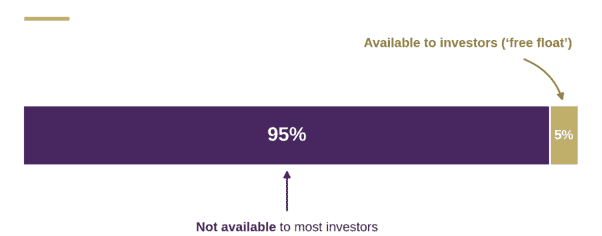
While a large IPO may appear immediately significant, its actual impact on an investment portfolio depends on several factors, including how much of the company is available for public trading (free float), the eligibility requirements of index providers, and how fund managers approach IPOs. In practice, even very large companies may initially float only a small proportion of their shares, meaning that the amount available to investors at the point of listing can be relatively limited. By way of example, SpaceX is expected to float in the region of 5% of its total company.
In simple terms, the freely floated stocks in a company represent what investors can actually buy. Some companies list the vast majority of stock, meaning ownership is largely public. Microsoft is one such example. Others may choose to list only a small proportion, with the remainder being owned by others such as founders, employees, or other stakeholders.
The distinction is important because most market indices, and the funds that track them, weight companies based on free float adjusted market capitalisation. As a result, a company may have a very large market capitalisation (i.e. its total size), but if only a small proportion of shares are freely available its weight within an index, and therefore in portfolios, can be materially smaller. The figure below illustrates the phenomenon.
It is worth noting that this is not the first time such a phenomenon has occurred. Saudi Aramco is a recent example that headline size and index weighting are not the same thing.
In 2019, Saudi Aramco floated less than 2% of its shares, and its valuation meant it was the biggest listed company in the world. However, with the small quantity of shares floated, few investors would see this stock appear in the portfolio’s top stock holdings despite being the biggest listed company in the world.
This is not being used for a review of the IPO, but to evidence that float-adjusted index weights reflect the shares actually available to buy rather than the full theoretical value of the company.
It is also important to recognise that this effect can evolve over time. IPOs may include “lock-up” provisions, which restrict existing shareholders from selling their holdings for a defined period after public listing. As these restrictions expire, additional shares may come to market, gradually increasing the free float and, in turn, the company’s weight in indices and portfolios.
Index inclusion is also not immediate or guaranteed. Major headlines have evolved around Nasdaq’s inclusion rules and show why concerns may exist.
They create a faster pathway for the very largest new listing to enter the Nasdaq 100, and this can create real price pressure when a large company lists with limited shares available to trade.
However, the Nasdaq-100 is not the whole market.
Other major index providers apply specific criteria that determine both eligibility and timing of entry. In some cases, index providers may accelerate inclusion for large companies, but weighting is still typically based on free float, which can limit initial portfolio impact. These can include:
- Minimum total and float-adjusted market capitalisation (e.g. >$10bn)
- Minimum free float (e.g. 10% of company, or greater than $2bn)
Other fund managers may operate differently and may have other, more flexible rules for inclusion. In practice, some strategies delay investment, reflecting the view that there can be a lack of price discovery soon after listing.
What does this look like in reality?
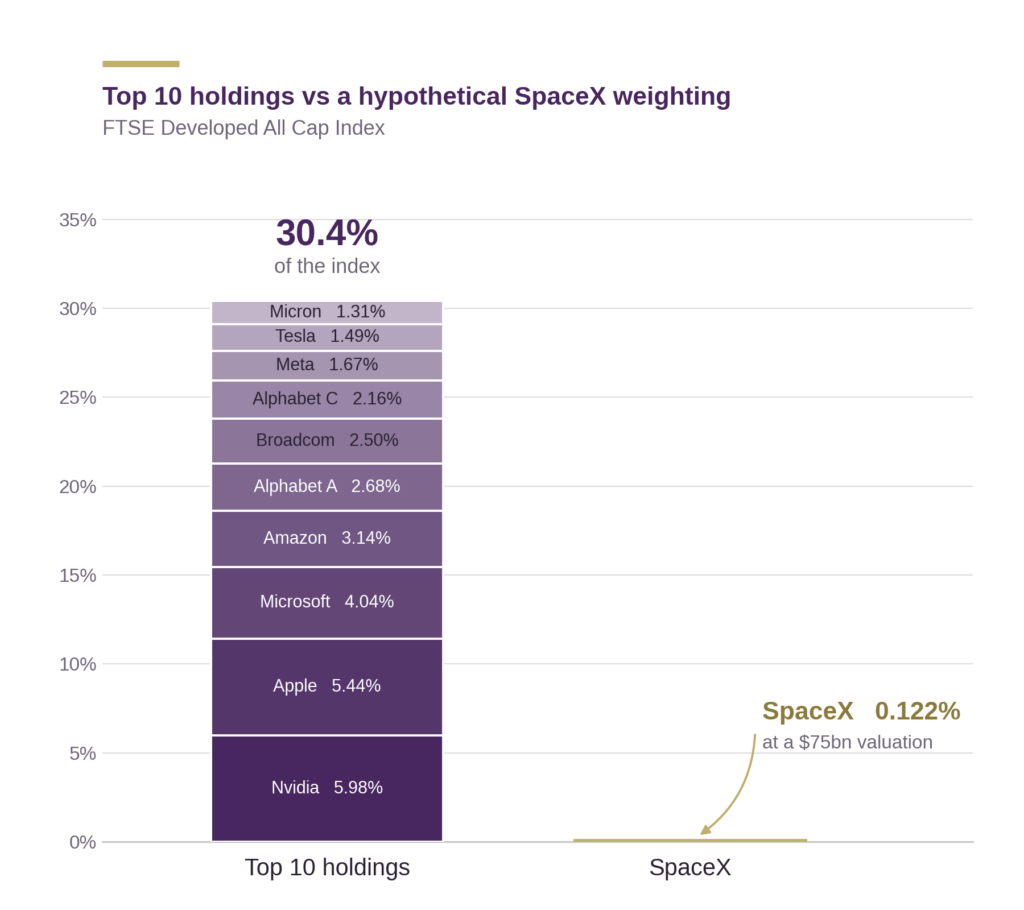
The picture is difficult to fully understand until all of the details are known. If we assume SpaceX’s free-float is 5% on a $1.5 trillion market capitalisation, this would equate to $75 billion of shares being tradable.
Within Portfoliosense®, there are two indices tracked for the broad developed market exposure: MSCI World (Global portfolio range) valued at just over $90 trillion, and FTSE Developed All Cap Choice Index (Earth portfolio range) valued at just over $61 trillion, both as at 29 May 2026. The following chart compares the top 10 companies of each index and their weightings, compared to an estimated weighting for SpaceX based on the above assumptions:
IMPORTANT NOTES
This is a purely educational document to discuss some general investment-related issues. It does not in any way constitute investment advice or arranging investments. It is for information purposes only; any information contained within it is the opinion of the authors and may change without notice. Past financial performance is no guarantee of future results.
PRODUCTS REFERRED TO IN THIS DOCUMENT
Where specific products are referred to in this document, it is solely to provide educational insight into the topic being discussed. Any analysis undertaken does not represent due diligence on or recommendation of any product under any circumstances and should not be construed as such.